 a black rainbow over downtown New Orleans
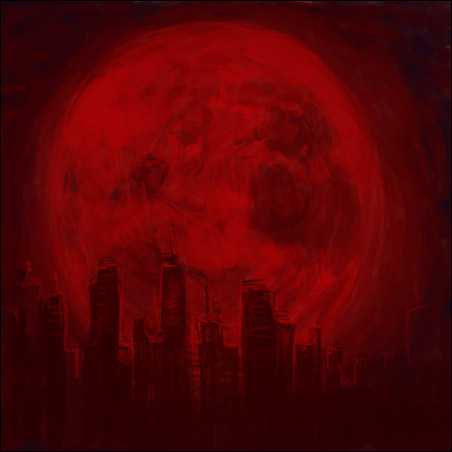
I could see the bridge all the way to the second stanchion. Here and there clouds had torn away from the black sky. Something was burning down between the waterfront buildings. We rushed across fifty feet of pavement. Just before the bridge mouth, it looked like someone had grenaded the road. A slab of asphalt practically fifteen feet high jutted up. Down the crack around it, you could see wet pipes, and below that, flickering water. Above, that amazing, loud lightning formed its searing nodes among the cloud canyons. [Dhalgren, Samuel R. Delaney, p. 874.]
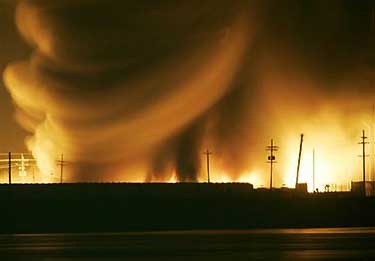
[New Orleans webcam] [Outpost Crystal: Survival of New Orleans blog - Or, Why It's a Good Idea to Know Your Shit]
NEW ORLEANS — Storm victims were raped and beaten, fights and fires broke out, corpses lay out in the open, and rescue helicopters and law enforcement officers were shot at as flooded-out New Orleans descended into anarchy Thursday. "This is a desperate SOS," the mayor said. [story]
No -- this isn't anarchy. This is simply the rupture of the facade of global capital, the destruction of social mores via the ultimate devastation of infrastructure, doing nothing more nor less than revealing, quite simply, and aptly, the social anger, the vengeance, not merely of "the criminal elements" or "a few bad apples" as has been quoted, but of the poorest classes of the United States. And in the U.S., by default (and what a default), the black classes [1]. It's impossible to avoid or forget the poverty in New Orleans. A city on the edge, not only sunk between levees, but constantly awaiting its chance for historical redress. And now, treated like chattel .. Is it any surprise that these conditions, in a state which is now stateless, have reached their culmination ? The poor and black classes have always known this was to be their fate when the hammer falls - is it any surprise they are fighting in ways which appear mad, but make all the more sense when the world is no longer ?
They had no food, no water, and no medicine for the last three days, until today, when the National Guard drove over the bridge above them, and tossed out supplies over the side crashing down to the ground below. Much of the supplies were destroyed from the drop. Many people tried to catch the supplies to protect them before they hit the ground. Some offered to walk all the way around up the bridge and bring the supplies down, but any attempt to approach the police or national guard resulted in weapons being aimed at them. [...] Any attempt to flag down police results in being told to get away at gunpoint. [...] The people are so desperate that they're doing anything they can think of to impress the authorities enough to bring some buses. These things include standing in single file lines with the eldery in front, women and children next; sweeping up the area and cleaning the windows and anything else that would show the people are not barbarians. [...] The buses never stop. [Interdictor - post]
Who's perspective ? Who's got the truth ? We hear: "when the National Guard is beaten back, when shots are fired at rescuers, when a mob mentality takes over, when desperation sets in." Yet in the firestorm this becomes something else: the potential for a desire for the End that gradually overwhelms the desire to survive, a desire for the eschatological climax, murder, for the catastrophe to find its final arc in mass self-destruction: a spiral of total societal suicide in the throes of control. And here I speak not only of the "looters," but all the fantasies of the military & the police. And at the same time - "looters" trade goods on neutral ground - guns, cigarettes and liquor are taken, leaving food behind - all the vestiges of pleasure and capital, the archetypal comforts of the social, are resurrected in the chaos, to no end, for no purpose. People become ghosts.
When hospitals can't take care of people and the rescuers need rescued [sic], there's no social fabric left, Andress said. [story]
What's left is not "no social fabric," but the threads of the fabric that held an inequal, unjust, imbalanced and impoverished "society" together, the support structure vanquishing its ultimate fear: to be truly and finally forgotten, left to die. To act-out what nightmares prepared their birth. That these are tapestries of revenge, of violent appropriation, of rape and beating -- is it any surprise that Hunter S. Thompson asked of us to read the Book of Revelations while arming himself in his fortified, mountain compound ?
No longer does any of this come across shrill: it already is apocalyptic. It has become a fiction in reality, a nonfiction of fact that catastrophe has struck New Orleans. But it has not struck equally ..
And from where ? From what future ? At which point did possibility slip to impossibility in the cool, calculated destruction of the Mississippi river's wetlands, its massive estuary and delta that provided natural protection against hurricanes ? This was no "natural" disaster, but a man-made, ecological time bomb. Will we witness a U.S. Administration telling us that a planetary onslaught of ecological disaster has little to do with global warming, with mass effects of pollution, with the destruction of the earth's protections to its system of violent upheaval and change ?
And what of a nation that seemingly can't provide for itself, can't come to terms with its own disasters, which even linguistically must possess a media-object of the other: "this is our tsunami" ? What of a nation that has failed its poor in the most obscene of gestures, when the arrival of 300 troops, fresh from Iraq, carrying M-16s and "locked and loaded," is met with relief, for yes! they will kill our own people ?
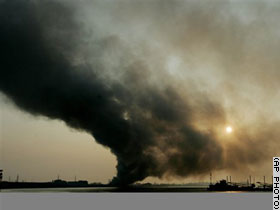
... corpses floating in flooded streets; scores of police officers simply abandoning their posts to flee a city gone at least temporarily mad. [...] New Orleans Mayor Ray Nagin was equally blunt. Federal and state officials need to stop having "goddamn press conferences" and get the relief effort rolling, he said in a late-afternoon radio interview, an angry flare-up out of character for the popular, generally easy-going former cable TV executive. [...] Scores of New Orleans police had simply gone AWOL and fled, according to a ranking NOPD officer, who spoke on condition of anonymity. [...] "It's like Iraq," one veteran war correspondent remarked. "But the difference is that we don't have the army to embed with." [...] [story]
When the Mayor loses his shit finally (and for good reason), once and for all, when police officers quit, yet keep their guns, when the media flees, because they have been for too long pampered by protectionism and authoritarian spin ?
What the fuck kind of country have we turned into where we can't provide for our people in a situation like this? I would expect this kind of thing in a country with no infrastructure at all, a country where basic human needs are a luxury. Is this where the constant budget cutting has gotten us? We seem quite well equipped to pump endless amounts of money and staff into ridiculous military campaigns. But when people here need help, they literally get left behind. There's just no excuse. None of this had to happen. [emmanuel @ 2600.com]
Brian Massumi and others have laid it out .. compassion has never been possible in Bush's language nor his affect. When speaking of vengeance, of bloody justice, his voice rings true and strong. But when faced with the immanent peril of his own people, he can only stutter and promise patience, that help is on the way. Unlike the war presidents he so dearly wishes to emulate, he cannot rally his own people for, quite simply, they have never been a concern of the machinery, of the elite, of that other black power--oil.
Tourist Debbie Durso of Washington, Mich., said she asked a police officer for assistance and his response was, "'Go to hell - it's every man for himself.'" To make matters worse, the chief of the Louisiana State Police said he heard of numerous instances of New Orleans police officers - many of whom from flooded areas - turning in their badges. "They indicated that they had lost everything and didn't feel that it was worth them going back to take fire from looters and losing their lives," Col. Henry Whitehorn said. [story]
Them white people gonna get you, nigger! Them white men gonna kill us 'cause of what you done today to that poor little white girl! You done smashed up the store windows, broke all the streetlights, climbed up and pulled the hands down from the clock! You been rapin' and lootin' and all them things! Oh, God, there's gonna be shootin' and burnin' and blood shed all over! They gonna shoot up everything in Jackson. Oh, God, oh, God, don't touch me! [Dhalgren, p. 869]
The city of Bellona has been altered in a strange cataclysm. The familiar laws of physics don't entirely hold. You can't quite be sure of distance and direction. Fires break out at random, and burn inconsumably. Buildings twist and collapse. The dense fog almost never clears; smoke and debris are everywhere. The city is largely depopulated. The few remaining inhabitants scavenge in the rubble. They make a living out of waste and ruin. There are always more abandoned supermarkets to plunder, always more empty apartments in which to squat. The destruction is never-ending, but it is also never total. Even after the apocalypse, life goes on. The activity is as frantic as it is pointless. Neurotic white people hold dinner parties and pretend to go to work, striving to maintain a facade of bourgeois normalcy. Multiracial gangs roam the streets, disputing empty turf. Cliques and factions rapidly form, and just as rapidly dissolve. Earnest social workers make their rounds. [...] What good is a proper name, when you're stranded at the exhausted end of time? All enterprise is futile. Tomorrow will be no different from today. Time cannot be used productively; it can only be wasted. Dhalgren is a huge, beautiful paean to wasting time. There's nothing left to do, except fuck, fight, and party. [Steven Shaviro on Dhalgren, from Stranded in the Jungle, chapter 7.]
[1] Abe rightly points out -- and I agree, of course, as this statement wasn't meant to be exclusionary -- that poverty knows no skin barriers, it's also white trash, Cajun, Chicano, Mexican, Creole and of course Native Indian, not to mention various immigrant classes, that deserve the "default." But I say "default" in the sense that, if the media is to portray a black or homeless person, a criminal or poor person, the image is, by default, black. By default might be a way of expressing certain blind media practices that overrule and overdetermine, that is, reproduce, realities.
posted. Thu - September 1, 2005 @ 08:53 PM |
..ziP:
./them.hallucinates./.
.this blog sketches patterning / [tV] -- everything here is in-progress, often a mess of thoughts and poorly edited grammar.

.. @rchives //
XML/RSS feed.me //
numbers that mean little:
absolut numerosity..:
...puplished 0n: Sep 02, 2005 11:50 PM
...puplished 0n: Sep 02, 2005 11:50 PM